
GUIDE · bigbunny
Bonus wagering: 3 × of which amount?
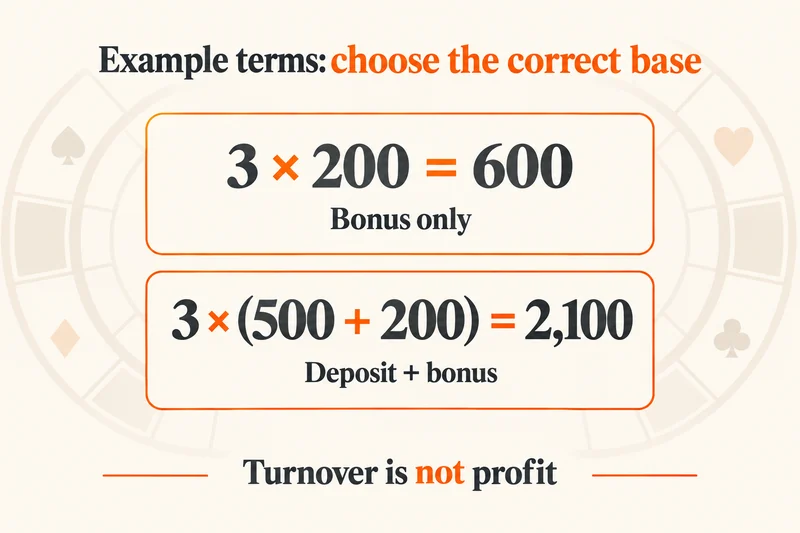
A wagering multiplier is incomplete without its base. “3 × the bonus” and “3 × the deposit plus bonus” produce different totals even when the multiplier is identical. Read the amount being multiplied before treating two terms as equivalent.

The base changes the result
The UK Gambling Commission glossary describes wagering requirements in terms of total wager value, which may be a fixed amount or a multiple of a deposit or bonus. It also identifies varying game contribution as a significant condition. We checked this terminology source on 8 October 2026; it is British guidance, not a statement of Philippine law or approval of any offer.
Consider two fictional wordings. Assume a 500-unit deposit and a 200-unit bonus. These are arithmetic inputs only; neither row describes a current promotion.
| Assumed wording | Calculation | Required qualifying turnover |
|---|---|---|
| 3 × the bonus | 3 × 200 | 600 units |
| 3 × the deposit plus bonus | 3 ×(500 + 200) | 2,100 units |
The second calculation uses a 700-unit base. Its total is 1,500 units higher. Dividing one headline multiplier by another would miss that difference because both headline multipliers are 3 ×.
Turnover credit can differ from the stake
For a separate hypothetical condition, suppose a qualifying 40-unit wager contributes 50% toward the requirement. Its contribution is 40 × 0.50 = 20 units. If the starting requirement were 600 and there were no prior credits or other adjustments, 580 would remain.
The example does not say every game contributes 50%, or that a void or excluded wager earns credit. Those conditions must come from the actual terms. Use the contribution rate for the relevant action instead of assuming that all amounts shown in a history count in full.
Three quantities should stay separate
Stake is the amount assigned to an individual wager. Qualifying turnover is the amount the stated conditions credit toward the requirement. Profit or loss is a different result of the underlying play. A wager can contribute to turnover and still lose money.
For that reason, 600 units of qualifying turnover is not 600 units of profit, and it is not a prediction of how much money will be spent or lost. It also is not money owed to the operator. A remaining requirement is a condition attached to the offer, not a reason to keep gambling.
Read the amount and the deadline together
Once the correct base and contribution rules are identified, preserve the terms that define the time window and the treatment of restricted funds. Completing a turnover condition alone does not establish that every balance is withdrawable or that all other conditions are satisfied.
The claim, spin and wagering-deadline example explains why separate clocks can start at different events. That timing check complements the amount calculation here; it should not be used to invent an extension or a deadline.
Keep the exact base wording beside the multiplier in any comparison note. The promotion terms guide hub contains related explanations, and the bigbunny homepage links the wider library.
Source-based editorial research and original examples. Sources checked 2026-10-08.