
Lottery odds notation: one in six, one to five and five to one
A chance of one in six corresponds to odds of one to five in favour, or five to one against. These expressions can describe the same event. They count different things: probability compares the event with all outcomes; statistical odds compare the event with its opposite.
A ratio without a label is easy to misread. This guide in the bigbunny lottery section uses six fictional, equally likely outcomes to make the denominator visible. It explains notation, rather than verifying a real lottery’s chances or a current operator’s payout.
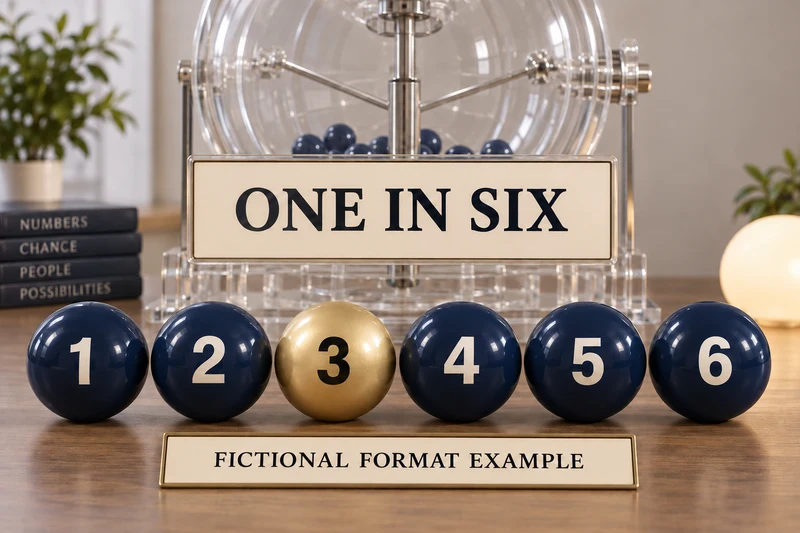
Start with six equally likely outcomes
Imagine a teaching draw with six possible results, numbered 1 to 6. Exactly one result, number 3, is the event being counted. The other five results are not that event. Assume each of the six results is equally likely, and that this example concerns a single draw.
The probability is one favourable outcome divided by six total outcomes: 1/6, approximately 16.67%. “One in six” means the denominator includes both the favourable outcome and the other five.
Odds in favour compare the one favourable outcome with the five unfavourable outcomes. They are 1:5, read as “one to five in favour.” Odds against reverse those two groups: 5:1, or “five to one against.” Neither form introduces a seventh possible result.
| Label for the same fictional event | What is being compared | Notation |
|---|---|---|
| Probability | Favourable outcome : all outcomes | 1/6, or one in six |
| Odds in favour | Favourable : unfavourable | 1:5 |
| Odds against | Unfavourable : favourable | 5:1 |
Why “one in five” changes the probability
If the probability were one in five, there would be one favourable part out of five total parts, leaving four unfavourable parts. That gives 1/5 = 20%, odds of 1:4 in favour and 4:1 against. It is not another spelling of the six-outcome example.
The phrase “five to one in favour” is different again. It describes five favourable parts for every one unfavourable part, so the probability is 5/(5 + 1) = 5/6, approximately 83.33%. The direction label matters as much as the numbers.
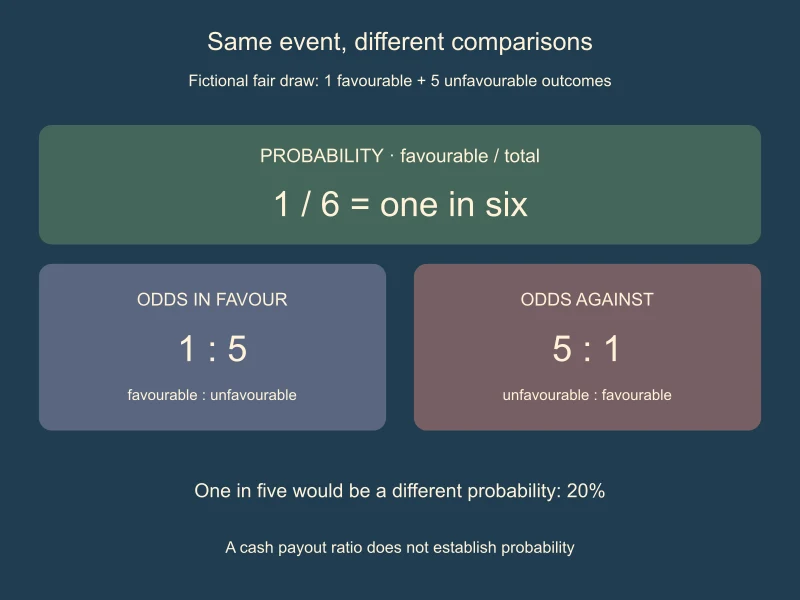
Convert a labelled ratio before using it
For odds a:b in favour, probability is a/(a + b). For odds a:b against, probability is b/(a + b). The same denominator contains both groups; the numerator changes because the order of the groups changes.
Penn State’s STAT 800 explanation of odds defines odds using the probability of an event relative to the probability of its complement, p/(1 − p). Its definition supports the conversion. The lottery illustration and all numbers in this guide are our own teaching example, not figures supplied by Penn State for a gambling product.
As a check, use p = 1/6. Then p/(1 − p) = (1/6)/(5/6) = 1/5, the numerical value of odds 1:5 in favour. Writing 1/5 at this step does not change the event’s probability to one in five: it is the value of the odds ratio.
A payout ratio is a separate statement
A label such as “5:1 payout” may concern a money calculation. It does not, by itself, establish five-to-one statistical odds against an event. A payout may be set independently of the event’s probability, and the treatment of the original stake also needs a clear rule.
Before using a ratio, identify what its two sides represent. Is the text describing favourable and unfavourable outcomes, net profit relative to stake, or total return relative to stake? If the page supplies only “5:1” with no explanation, record the meaning as unresolved. Do not infer probability from a cash multiplier.
The notation does not promise a waiting time
“One in six” describes the assumed probability of the specified event in one draw. It does not promise that the sixth attempt will produce it, or that every block of six draws contains exactly one occurrence. Understanding the ratio is the first step; interpreting repeated draws is another question.
The existing guide to why a one-in-a-million chance does not fix a winning draw explains that separate waiting-time issue. Use it after the probability has been established, without treating previous misses as a change to the next draw’s stated model.
Write the event and the direction beside the number
A useful note for this example is: “One fair fictional draw; result 3 among six possible results; probability 1/6; odds in favour 1:5; odds against 5:1.” If a real page uses different conditions, repeated digits or several winning events, establish those conditions before converting anything.
Source and calculations checked on 10 October 2026. This guide provides a way to read and verify notation. It establishes no real product’s fairness, current prize rule or expected result.