
PCSO 4D, 3D and 2D Lotto: exact odds and expected prize per ₱10 play
Published — UTC
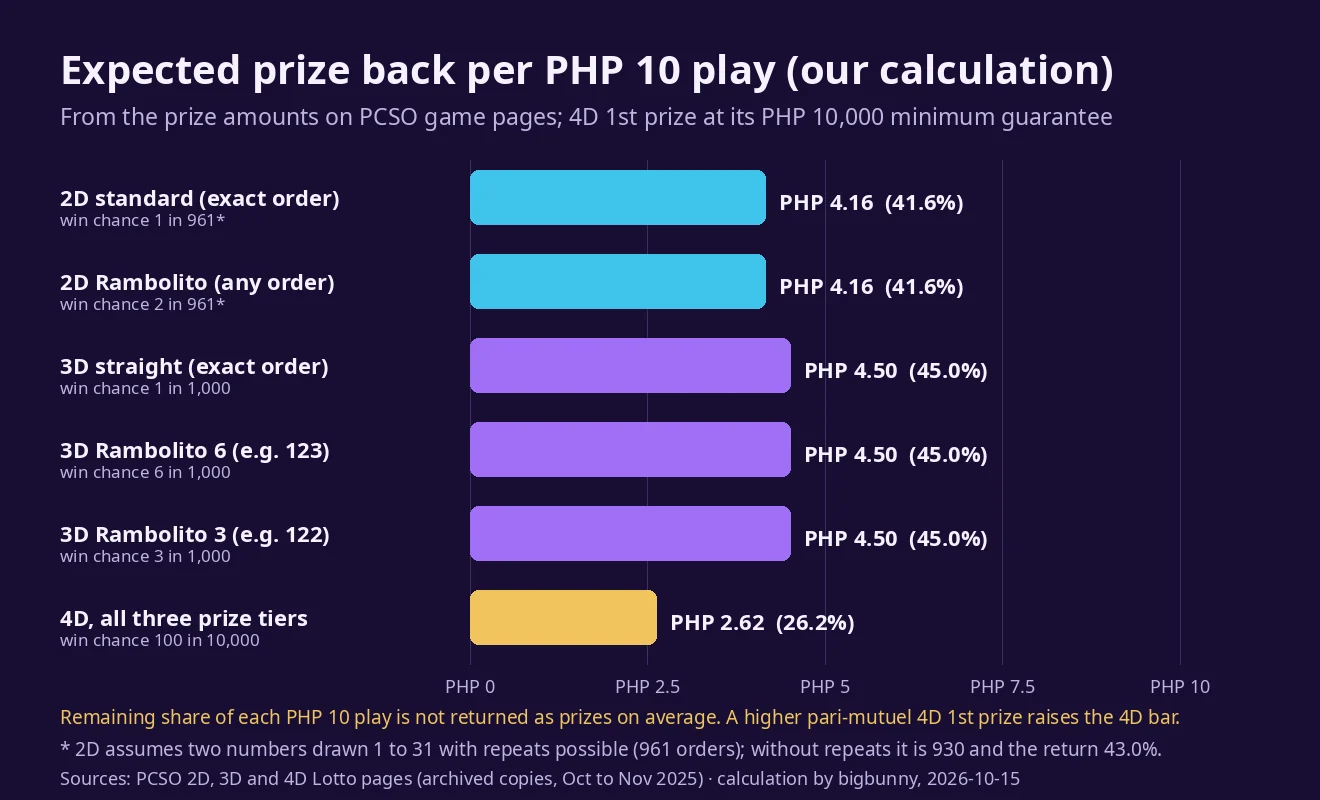
Short answer: on the prize amounts printed on PCSO’s own game pages, a ₱10 play in 3D Lotto returns ₱4.50 in prizes on average (45%), whether you play straight or Rambolito. A ₱10 play in 2D Lotto returns about ₱4.16 (41.6%), and a ₱10 play in 4D Lotto returns ₱2.62 (26.2%) when the first prize is at its ₱10,000 minimum guarantee. The exact chance of a straight win is 1 in 1,000 for 3D, 1 in 10,000 for the 4D first prize, and 1 in 961 for 2D if both numbers can repeat. Rambolito and perm (rambol) plays raise the chance of winning something, but they do not change the share of money that comes back, because the prize per ₱10 is cut in exact proportion to the extra orders you cover.
These figures are bigbunny’s own arithmetic from PCSO’s published prize rules, not PCSO statistics and not a forecast of any draw. Each draw is independent, and nothing below makes a number more or less likely to appear. Sources were checked on 15 October 2026.
Where the prize rules come from
All prize amounts, draw times and play types are from the Philippine Charity Sweepstakes Office’s game pages for 2D Lotto, 3D Lotto and 4D Lotto. The PCSO site refused our automated request on the day of checking, so the wording was read from public archived copies of the same pages captured between October and November 2025 (2D copy, 3D copy, 4D copy). If PCSO has changed a prize since then, the live page and the ticket terms prevail, and the arithmetic below should be redone with the new amount.
| Game | What you pick | Prize per ₱10 play (PCSO) | Draws (PCSO) |
|---|---|---|---|
| 2D Lotto | Two numbers from 1 to 31, exact order | Standard ₱4,000; Rambolito ₱2,000 | Daily, 2PM, 5PM and 9PM |
| 3D Lotto | One digit 0 to 9 in each of three columns | Straight ₱4,500; Rambolito 6 ₱750; Rambolito 3 ₱1,500 | Daily, 2PM, 5PM and 9PM |
| 4D Lotto | One digit 0 to 9 in each of four columns | 1st: pari-mutuel, minimum guaranteed ₱10,000; 2nd (last 3 digits) ₱800; 3rd (last 2 digits) ₱100 | Monday, Wednesday and Friday, 9PM |
PCSO also states that the ₱10 play amount already includes the 20% Documentary Stamp Tax, that players must be at least 18 years old to buy tickets or claim prizes, and that prizes above ₱10,000 are subject to 20% tax under the TRAIN Law.
How many possible results each game has
Every exact-odds figure starts from the number of equally likely results. For 3D, three digits from 0 to 9 give 10 × 10 × 10 = 1,000 results, from 000 to 999. For 4D, four digits give 104 = 10,000 results. For 2D, the page says two numbers are chosen from 1 to 31 but does not say whether the same number can be drawn twice. If it can, there are 31 × 31 = 961 ordered results; if it cannot, there are 31 × 30 = 930. This article uses 961 and shows the 930 alternative wherever it matters. That point is marked as an assumption, not a PCSO statement.
Exact odds and expected prize per ₱10 (our calculation)
The expected prize is simply the chance of each prize multiplied by its amount, added together. It answers one narrow question: across a very large number of ₱10 plays, how much comes back as prizes on average? It says nothing about the next draw.
| Play | Chance to win | Prize | Expected prize per ₱10 |
|---|---|---|---|
| 2D standard | 1 in 961 | ₱4,000 | ₱4.16 (41.6%) |
| 2D Rambolito, two different numbers | 2 in 961 | ₱2,000 | ₱4.16 (41.6%) |
| 3D straight | 1 in 1,000 | ₱4,500 | ₱4.50 (45.0%) |
| 3D Rambolito 6 (e.g. 123) | 6 in 1,000 | ₱750 | ₱4.50 (45.0%) |
| 3D Rambolito 3 (e.g. 122) | 3 in 1,000 | ₱1,500 | ₱4.50 (45.0%) |
| 4D, all prize tiers combined | 100 in 10,000 | ₱10,000 / ₱800 / ₱100 | ₱2.62 (26.2%) |
With 930 possible 2D results instead of 961, both 2D rows become ₱4.30 (43.0%). Either way, 3D gives back the largest share of the three games on these published prizes, and 4D the smallest at its minimum first prize.
Why Rambolito changes the odds but not the return
Rambolito is PCSO’s name for a permutation play: you choose the digits and the terminal covers every order of them. In 3D, three different digits such as 1-2-3 can appear in six orders (123, 132, 213, 231, 312, 321), so the chance that one of them is drawn is 6 in 1,000. PCSO pays ₱750 per ₱10 for that win instead of ₱4,500. Six orders times ₱750 is exactly ₱4,500, the same as one straight prize, which is why the expected prize stays at ₱4.50 per ₱10.
A pair plus one digit, such as 1-2-2, has only three distinct orders (122, 212, 221). The chance is 3 in 1,000 and the prize is ₱1,500; again 3 × ₱1,500 = ₱4,500. The same logic holds in 2D: two different numbers can come out in two orders, and the Rambolito prize of ₱2,000 is half the standard ₱4,000.
The practical difference is variance. With Rambolito 6 you win more often (about once per 167 plays on average, against once per 1,000 for straight) but each win is one sixth the size. If your aim is “win something occasionally”, Rambolito fits it; if your aim is a larger single prize, straight fits it. Neither choice improves the long-run return.
4D: three prize tiers and a pari-mutuel first prize
4D pays three tiers per ₱10 play, all in exact order. A ticket is counted once, at its highest tier, so the chances below do not overlap (our reading of the tiers; the page does not state it in so many words):
| 4D tier | What must match | Chance | Prize | Expected value |
|---|---|---|---|---|
| 1st | All 4 digits | 1 in 10,000 | at least ₱10,000 | ₱1.00 |
| 2nd | Last 3 digits, first digit different | 9 in 10,000 | ₱800 | ₱0.72 |
| 3rd | Last 2 digits, third-from-last different | 90 in 10,000 | ₱100 | ₱0.90 |
The first prize is pari-mutuel: PCSO divides the allocated prize money among all winning tickets, with ₱10,000 per ₱10 play as the minimum guaranteed amount. When fewer people share the winning number, the first prize can be larger, and the expected prize rises with it. Because the other two tiers are fixed, the 4D expected prize per ₱10 is ₱1.62 plus the first prize divided by 10,000:
| 4D 1st prize per ₱10 (hypothetical) | Expected prize per ₱10 |
|---|---|
| ₱10,000 (minimum guarantee) | ₱2.62 (26.2%) |
| ₱20,000 | ₱3.62 (36.2%) |
| ₱28,800 | ₱4.50 (45.0%), the same as 3D |
| ₱50,000 | ₱6.62 (66.2%) |
The first prize would have to reach about ₱28,800 per ₱10 before 4D matched 3D’s return. Since the size of a pari-mutuel prize is only known after the draw, a player cannot use this to choose a better draw in advance.
A worked 4D perm (rambol) example
PCSO lets 4D players buy a perm, one ₱10 straight play on every order of the chosen digits. Its own cost table lists 24 combinations (₱240) for four different digits, 12 (₱120) for one pair, 6 (₱60) for two pairs and 4 (₱40) for a triple. Take the four different digits 4, 7, 0 and 2, so 24 tickets for ₱240. The chance that the drawn number is one of your 24 orders is 24 in 10,000 (0.24%).
Because several of your tickets share their last digits, one draw can pay more than one ticket. If the result is 2074, ticket 2074 wins the first prize, and ticket 0274 also ends in “74”, so it wins the ₱100 third prize: at least ₱10,100 back on ₱240. If the result is 5074, none of your orders matches all four digits, yet ticket 2074 matches the last three digits (₱800) and ticket 0274 matches the last two (₱100): ₱900 back on ₱240. Wins like this make a perm feel productive, but the long-run return of the whole perm is still 26.2% at the minimum first prize, because each of the 24 tickets is an ordinary ₱10 play.
Tax, claiming and the ₱10,000 line
PCSO’s pages list where prizes can be claimed: ₱20 up to ₱10,000 at any authorised lotto outlet, up to ₱500,000 at PCSO branch offices, and any amount up to the jackpot at the PCSO Main Office. They also state that prizes above ₱10,000 are subject to 20% tax. A single ₱10 straight win in 2D or 3D stays below that line, but larger plays can cross it: a ₱30 straight 3D play on the winning number pays 3 × ₱4,500 = ₱13,500. How the tax is computed on such a prize, and whether several plays on one ticket are treated together, is not explained on the game pages, so confirm it with PCSO before relying on a net figure.
Verified, calculated, assumed and not verified
Read from PCSO game pages (archived copies, 2025): number ranges, exact-order rule, prizes per ₱10 play, Rambolito and perm types and costs, the 4D minimum guaranteed first prize and pari-mutuel basis, draw times, the 18+ rule, DST inclusion, claim locations and the 20% tax line.
bigbunny’s calculation: the number of possible results, every chance and expected-prize figure, the 4D tier split and break-even first prize, and the perm example.
Assumption: 2D results allow a repeated number (961 results). The page does not say; with 930 results the 2D figures become ₱4.30 per ₱10.
Not verified: whether any prize or rule changed after the archived copies; how the 20% tax is computed on combined plays; the share of ticket sales that funds the 4D first prize; and draw-by-draw first-prize amounts. Check the live PCSO page and your ticket before playing.
Before you play
Lottery play is for adults; PCSO’s own pages set the age at 18. Treat each ₱10 play as the price of entertainment rather than a way to earn money: on the published prizes, every game returns well under half of what is played on average, and no system of number choice changes that. Set a fixed budget per week, do not increase plays to recover losses, and keep tickets and receipts safe until the result is confirmed.
Sources (checked 15 October 2026): Philippine Charity Sweepstakes Office: 2D Lotto, 3D Lotto and 4D Lotto game pages, read through Internet Archive copies captured 23 November 2025, 28 November 2025 and 13 October 2025. All odds, expected values and worked examples are bigbunny’s own calculations.